All exhibitions of the Nippon Suiseki Association are supported by the
Japanese Agency for Cultural Affairs and the Tokyo Metropolitan Government.
In this section we would like to introduce the basic shapes or forms of
suiseki, and the Japanese terminology used to classify them.
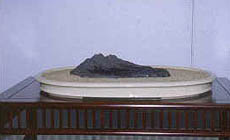
This is perhaps the most common form of suiseki, resembling a distant mountain.
The Japanese expression “Suiseki begins with toyama, and ends with toyama”
means that this is the usual starting point for most people who are new
to the art. As your appreciation develops, then you will move on to enjoy
other shapes and forms, but in the end will eventually return to this distant
mountain shape.
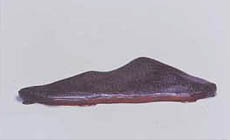
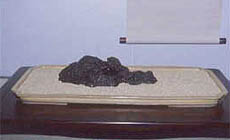
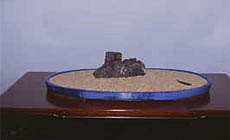
Suiseki categorized as “shimagata-ishi” have island-like forms, whereas “iwagata-ishi” refer to those resembling seaside cliffs. Suiban display is usually recommended for these types.
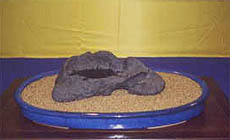
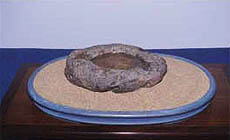
These are waterpool stones, and the balance and location of the pool is
very important with these.
Copyright
(C) Nippon Suiseki Association. All Rights Reserved.